

Emergency roof tarping that stops damage from spreading — Minnesota
When hail, wind, or ice opens your roof, the next rain is not a theory — it is a deadline. We install professional temporary protection, document conditions for your insurance file, and line up permanent repairs with Minnesota code and manufacturer rules in mind.
Call 855-635-KING or text 855-635-5464
24/7
Emergency intake when water is active
BC695228
Minnesota general contractor license
Forensic
Photo documentation aligned with carrier expectations
Why how we tarp matters
Loose blue plastic fails in Minnesota wind and ice. We prioritize form-fitted temporary barriers and shrink-wrap style coverage when the job calls for real protection, not a flyer promise.
Side-by-side: traditional loose tarping versus a form-fitted temporary barrier. Framing keeps attention on the rooflines and temporary protection — full-bleed photos with matched aspect ratio for a clean, high-contrast layout.
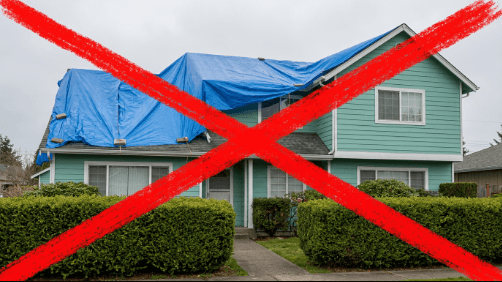
Loose plastic is not a roof — it is a gamble
Gaps, flutter, and blow-offs funnel water into soffits and walls. Repair King documents conditions and installs temporary protection that matches exposure, pitch, and code — not a one-size sheet held down with hope.
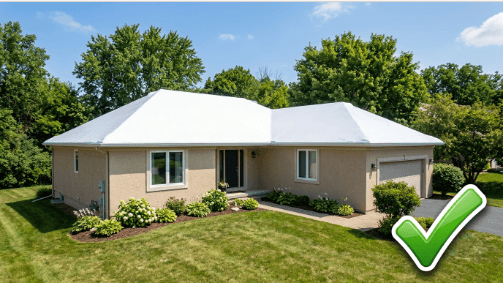
Form-fitted coverage that follows your roof
Heat-shrink style membranes hug ridges and valleys so wind can't work under the edge. When you need a real pause button before permanent repairs, this is the class of temporary work we bring across Minnesota.
When to call immediately
Emergency tarping is not “optional maintenance” — it is damage control
If any of these situations match your home or building, treat the clock as running. Temporary protection is almost always cheaper than replacing soaked insulation, drywall, flooring, and personal property.
Active interior water
Stains spreading across drywall, drips in closets, or bubbling paint mean water is migrating through insulation. Speed matters — mold follows moisture faster than most homeowners expect.
Post-storm openings
Wind peel-back, tree impacts, and lifted ridge or valley metal can turn the next rain cell into a flood event. Tarping buys time until full forensic documentation and permanent repairs align.
Claim-ready documentation
Carriers want dated photos, cause-and-effect narratives, and scope tied to code. We build the file while we protect the structure — not weeks later from memory.
Commercial & portfolios
Flat roofs, mechanical screens, and tenant-occupied buildings need plans that protect people, equipment, and revenue. We scale response for property managers and owners.
Why professional tarping matters
Minnesota roofs do not forgive slow decisions
The Upper Midwest throws a uniquely harsh sequence at assemblies: wind-driven rain in spring, humidity spikes after hail, freeze–thaw cycling around ice dams, and summer sun that cooks trapped moisture under compromised shingles. A small opening that looks manageable on a calm Tuesday becomes a ceiling collapse when the next front stacks moisture against a failed valley or a lifted starter course. That is why experienced Twin Cities contractors treat emergency tarping as both a craft and a sequencing decision — not merely “throw plastic until it stops leaking.”
A credible temporary install accounts for how water actually travels: wicking along felt, running horizontally on low slopes, entering at nail pops, backing up behind chimneys, and funneling through attic chases into closets and light fixtures below. We map the leak path when it is safe to do so, then choose anchor points and overlap patterns that redirect water away from the breach instead of trapping it against the deck. The goal is to buy dry, stable time — enough to photograph, estimate, and execute permanent repairs without your interior becoming a secondary insurance event.
Homeowners sometimes ask whether a blue tarp from a big-box store is “good enough.” In limited, low-risk situations with gentle pitches and mild weather, a homeowner may slow a drip — but steep slopes, two-story eaves, parapet walls, and commercial membranes demand engineered fastening, edge protection, and crew safety plans. The wrong fastener pattern can create new penetrations, void shingle warranties, or peel sheathing. Our licensed crews carry the equipment and training to work without turning your emergency into a liability story.
Scope of work
What our emergency tarping service includes
Every opening is different — a wind-peeled ridge cap is not the same problem as punctured TPO next to a rooftop unit. Still, most emergency responses share a backbone: protect life safety first, stop progressive water damage second, and preserve defensible documentation third. When you call Repair King, you are not getting a rushed patch; you are getting a structured response designed for Minnesota’s weather realities and for carriers that ask sharp questions after major metro storms.
- Interior and exterior assessment with photo set where safe and accessible
- Tarp specification matched to pitch, exposure, and surrounding terrain
- Anchor strategy that minimizes additional damage while holding wind loads
- Edge sealing and drainage checks to reduce blow-off and blow-under risk
- Discussion of next steps: repair, replacement, and insurance coordination if applicable
- Coordination with full-service restoration when siding, gutters, or interiors are involved
Storm season reality check
During widespread hail or derecho events across Hennepin, Ramsey, Dakota, and neighboring counties, phone queues spike and crews run long days. We still triage by severity: occupied bedrooms with active water, elderly and accessibility needs, electrical hazards, and commercial losses with business interruption pressure rise to the top. If we cannot answer live, leave details — silence is not indifference; it is demand. We return calls as quickly as operations allow.
If you are unsure whether your situation qualifies as urgent, describe what you see and hear. A faint stain that appeared after the last storm may still warrant inspection within days, but active dripping, spreading bubbles, or daylight visible in the attic means you should treat the situation as emergency-grade until a professional says otherwise.
Related service
For the full emergency repair pathway beyond tarping — including stabilization options and follow-up scopes — see our emergency roof repair page.
How we work
From first call to dry, stabilized roofline
Triage call
We capture address, leak location, storm date if known, and safety notes so dispatch routes the right crew and equipment.
On-site assessment
Exterior and interior walk-through, photo set, and discussion of immediate risks before anyone steps on a slope.
Temporary install
Tarp sizing, anchor strategy, and edge sealing matched to pitch, wind exposure, and material type — not one-size-fits-all.
Next-step plan
Repair vs. replacement pathway, insurance touchpoints if applicable, and scheduling for permanent restoration.
Insurance alignment
Documentation that keeps your file coherent
Insurance professionals see thousands of storm claims. The files that move efficiently share a pattern: dated photos, clear descriptions of the opening mechanism (wind peel, hail fracture, fallen limb, ice dam backup), and temporary repairs that look reasonable on invoice — not improvised hazards. Repair King is a licensed general contractor; we do not practice law or public adjusting, but we know how to present findings in language adjusters and desk reviewers recognize. When your policy covers emergency mitigation for a covered peril, temporary tarping may be reimbursable — subject to your deductible and contract language. We encourage you to notify your carrier promptly and keep records of every interaction.
If you are also navigating larger storm strategy questions — such as separating restoration scope from upgrade scope — our insurance claim roofing help and storm damage resources explain how we support code-aware scopes and clean documentation. For hail-specific workflows, start with hail damage roof repair.
Geography matters for response logistics. Repair King serves homeowners and businesses across Minnesota — all 87 counties — and Illinois, including Chicagoland and downstate communities listed on our service area pages. Same forensic documentation standard in every market we publish. On-site response times vary by location, season, and crew availability. Dense metro cores (e.g. Twin Cities and Chicagoland) often see the fastest scheduling; call to confirm timing for your address. Browse all service areas or jump directly to local landing pages:
Technical reality
Wind exposure, tarp weight, and why “tight enough” is a loaded phrase
A tarp that flaps is a tarp that fails. Wind gets under loose edges, works fasteners in cycles, and can peel protection off faster than the storm that caused the original damage. Experienced crews think in terms of exposure categories: how open your lot is to fetch across fields, how two-story walls create corner vortices, and how nearby tree canopies both shield and shed debris onto the roof. Those inputs change how we pattern overlaps, where we add batten strips, and how we sequence perimeter rolls so water sheaths off instead of damming against a ridge or parapet.
Material choice matters too. Consumer-grade covers vary wildly in UV resistance, tear strength, and grommet spacing. On steep slopes we favor solutions that can be tensioned without turning every nail into a new leak point. On low slopes we watch for ponding: a flat patch that holds water is sometimes worse than a controlled drain path to gutters. The point is not to impress you with jargon — it is to explain why two tarp jobs that look similar from the curb can perform very differently on night three of driving rain when the temperature is still dropping toward freezing.
Workmanship also intersects with ethics. We will tell you when a temporary fix is unlikely to survive a forecasted wind event, when interior drying should start immediately, or when a roof is so compromised that discussion shifts from tarping to broader stabilization. You deserve a contractor who will not sugarcoat risk just to book a truck roll. That candor is part of how Repair King has earned long-term trust across Minneapolis, St. Paul, and the surrounding metro communities we serve.
After the tarp is secure — what happens next?
Temporary protection should have an exit strategy. Sun and wind degrade plastic sheeting; fasteners loosen; ice can load edges unpredictably. We schedule follow-up inspections based on weather forecasts and the severity of the underlying damage. Sometimes a partial shingle repair and flashing rebuild resolves the loss; other times manufacturer guidelines and age dictate full replacement. If your roof is near end-of-life, tarping is the pause button — not the plan — and we will be direct about that tradeoff so you can budget and file accurately.
Interior restoration may run parallel: air movers, dehumidification, moisture mapping, and controlled demolition of unsalvageable drywall. We coordinate those trades when asked, keeping communication centralized so you are not chasing five subcontractors during an already stressful week. For property managers, that single-point accountability is often the difference between a controlled incident and a tenant-relations headache.
Finally, we respect your time and nervous system. Storm damage is disorienting — noise on the roof, unfamiliar insurance vocabulary, and worry about out-of-pocket costs. Our team focuses on plain-language explanations, realistic timelines, and predictable next steps. Repair King is a licensed General Contractor. We do not hold licenses as a public adjuster, attorney, or engineer. Any insurance claim handling, legal services, or specialized evaluations are performed exclusively by independent, licensed professionals we coordinate with.
FAQ
Emergency tarping questions — straight answers
How fast can Repair King install an emergency roof tarp in the Twin Cities?
Response times depend on call volume, weather severity, and crew routing. During widespread storms we triage by interior water, safety hazards, and structural risk. Leave detailed voicemail if lines are busy — we return calls in priority order. Same-day service is our goal when conditions allow, but we do not guarantee a specific arrival window during major metro-wide events.
Will emergency tarping fix my roof permanently?
No. Tarping is temporary weather protection to slow or stop water intrusion until a permanent repair or replacement can be completed safely. It is a bridge, not a cure. We document the opening, stabilize the situation, and then schedule the right long-term fix based on damage type, code requirements, and your insurance scope when applicable.
Does insurance cover emergency tarping after storm damage in Minnesota?
Many policies include emergency mitigation or reasonable temporary repairs when a covered peril opens the roof, but coverage depends on your contract, deductible, and carrier interpretation. We photograph conditions and can help you understand what documentation supports your file. Your adjuster makes the final coverage determination.
Is DIY tarping a good idea on a steep Minnesota roof?
Walking a wet, damaged slope is dangerous — especially with wind, ice, or compromised decking. Improperly anchored tarps can tear free, funnel water inward, or void manufacturer warranties if fasteners penetrate the wrong layers. If water is entering living space, prioritize safety and call a licensed contractor with fall protection and storm-response experience.
What should I do while waiting for the crew?
If safe, move valuables away from drips, bucket active leaks, and avoid attic access if ceilings are sagging. Turn off electricity in wet areas if outlets could be affected. Note the time you first saw water — that detail helps with insurance timelines. Do not climb the roof yourself to inspect; ground-level photos of interior damage can still be useful.
Do you tarp commercial flat roofs and multi-family properties?
Yes. Low-slope assemblies, TPO, EPDM, and built-up roofs often need different temporary details than steep-slope shingle work. We coordinate membrane-safe ballast strategies, perimeter fastening plans, and drainage checks so temporary protection does not create ponding. Property managers can also explore our Property Shield program for portfolio-level storm readiness.
Water doesn't wait — neither should you
Call Repair Kingfor emergency roof tarping across the Twin Cities. We'll stabilize the opening, protect your interior, and help you plan permanent repairs with clarity.
Repair King | MN License BC695228 | myrepairking.com